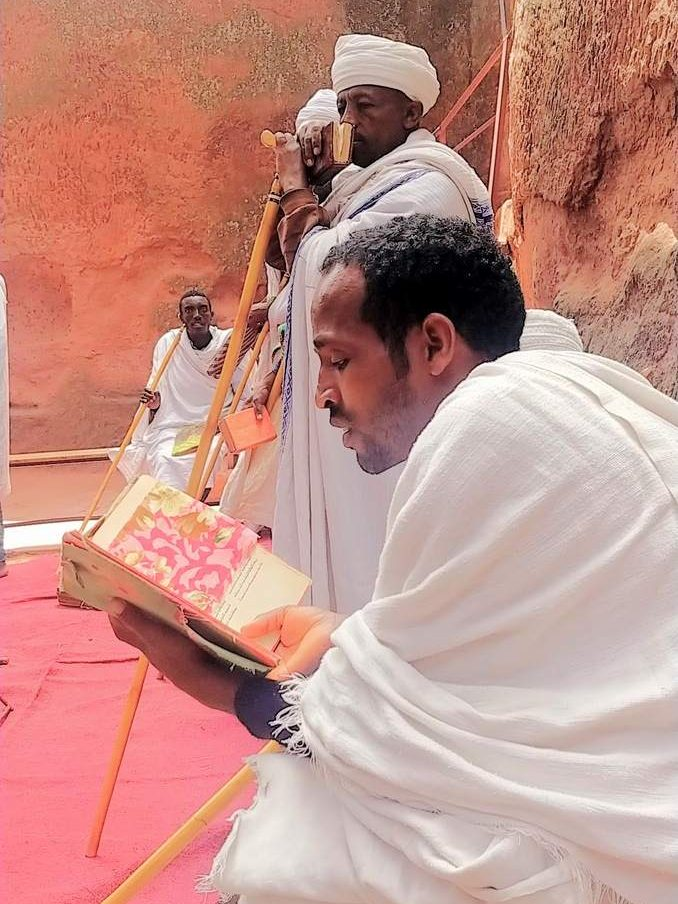
Bete Amanuel Church, Lalibela
Many scholars agree that Bete Amanuel Church is the most beautiful and finest of all the rock-hewn churches of Lalibela. This church has a pinkish-red color and is smoother than the other Lalibela churches. Some scholars suggest that Bete Amanuel was the royal family’s private chapel. It is 12 meters high, 18 meters long, and 10 meters wide. It is a monolithic church, completely freed from the surrounding trench at a depth of 24 meters.
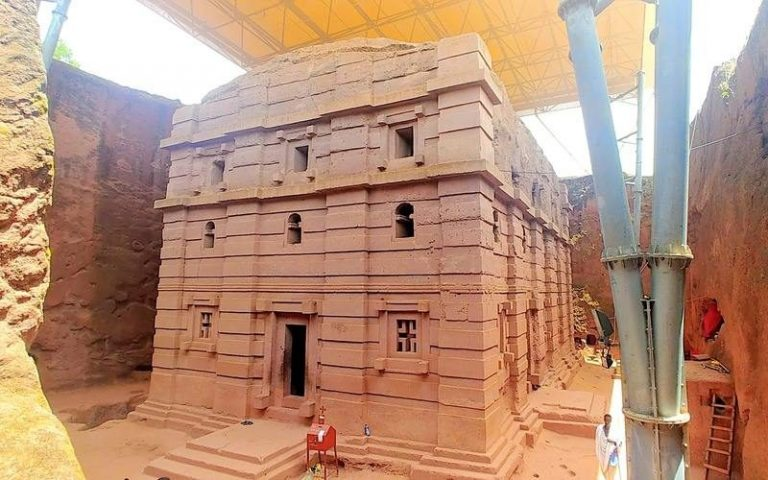
Bete Amanuel’s architectural style mimics the wood-and-stone buildings of the ancient Axumite architecture tradition, similar to the cave church of Yimrehane Kristos. Yimrehane Kristos is a church built inside a natural cave, and the walls of the church are made using projecting and recessing alternating layers of wood and stone. However, Bete Amanuel achieves this appearance through the carving of solid rock.
Certainly, the controversial heavyweight shelter erected by UNESCO has done more damage than good in protecting the church. Besides, the most elegant view of the church is marred by the massive structure. Urgent and competent conservation and restoration work is required. However, there seems to be little progress toward this goal at this time.
The church is supported by eight columns running in two rows in the east-west direction. Four of them are complete, while the others are carved on three sides. To the southwest is a lower gallery, accessible by a rock staircase leading from the side room. The double Axumite frieze in the nave is a very striking feature of the interior. Holes found at the bottom of the church lead to the churches of Bete Merkorios and Bete Gabriel-Rufael through long underground passages.
Outside the church, visitors can find the holy bee’s nest, which is believed to have special healing properties. The legend of Lalibela is connected to a flock of bees that completely swarmed him when he was born. The name Lalibela means “honey eater.”
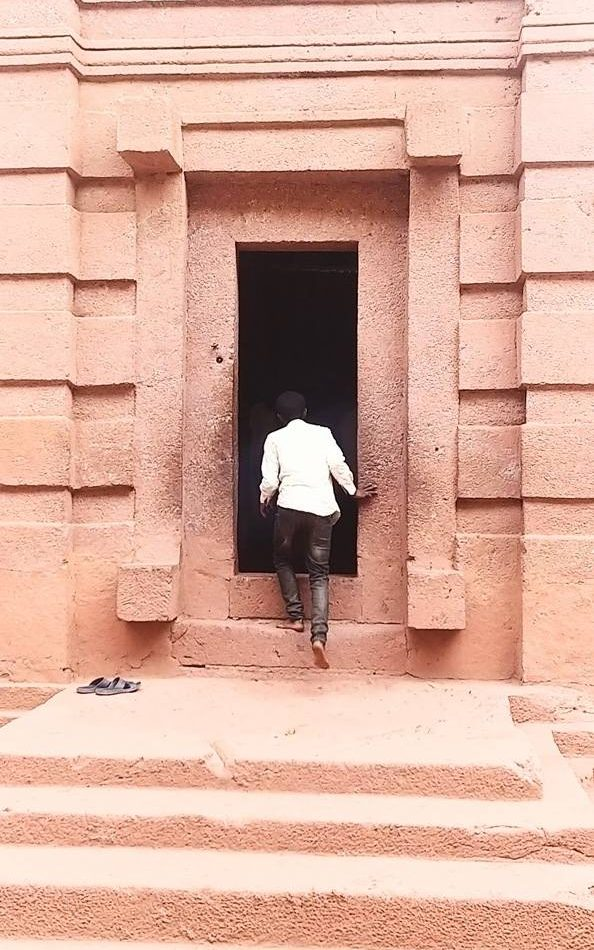
Main Entrance of Bete Amanuel Church
The main entrance is on the west side of the courtyard. It can be reached through a long rocky passage leading to the entrance. There is also another access point in the right corner of the southwest, coming from Bete Merkorios. This path passes through steep steps.
A third path enters from the east side of the courtyard through a hole that leads to several steps. Another entrance is located on the east side of the courtyard and passes through a group of churches in the north and a huge incision leading south through massive rock cuts that also connect to Bete Abba Libanos Church.